• Skip to primary navigation
  • Skip to main content
Brooks Szewczyk

Brooks Szewczyk

Connecting People To The Truth Of Christ

  • Blog
  • Contact
  • Show Search
Hide Search

Brooks Szewczyk

The Eternal Subordination of the Son: Definition, Biblical & Historical Arguments

May 7, 2021 By Brooks Szewczyk Leave a Comment

The topic of the eternal subordination of the Son (ESS) has become a popular discussion among evangelical theologians in the last hundred years. This is an important discussion because it describes our view of the economy of the Trinity, the works of God, and the nature of Christ. Care and nuance must be given to defend the biblical position while affirming historical orthodoxy.

If you don’t know what some of this means, don’t worry. I’ll do my best to define everything as we go. I will also bold important points if it would be helpful for you to skim. Here is my table of contents:

  • How History and Scripture Work Together to Inform Us
  • How the Persons of The Trinity Might Work Together
  • What Is Eternal Subordination?
  • How Jesus Spoke of His Relationship with the Father
  • Eternal Subordination Arguments from The Epistles
  • The Distinction Between Ad Extra and Ad Intra
  • How Augustine Informs Eternal Subordination
  • How John Owen Viewed Eternal Subordination
  • Contemporary Arguments Against Eternal Subordination
  • Contemporary Arguments for Eternal Subordination
  • Eternal Subordination and The Glory of the Christ

The Bible teaches that our Lord Jesus is coequal and coeternal to the Father and yet eternally subordinate to God the Father. Christian discussions throughout history inform us on the nuance, implications, and composition of this issue.

How History and Scripture Work Together to Inform Us

Christian epistemology has always affirmed and must always affirm that the Bible is our only source of inerrant, infallible knowledge. The words of Scripture carry utmost authority, and they are God’s intended revelation of himself to humanity.

The climax of the Bible is the incarnation of Jesus Christ, God in the flesh, who gives us the most clear understanding of God. “For the entire fullness of God’s nature dwells bodily in Christ” (Colossians 1:1).

As such, our understanding of the nature of Christ and the relationships between the Father, Son, and Holy Spirit must be gleaned from Scripture. Nothing else has the authority to speak on the nature of God.

Throughout history, many Christian theologians have searched the Scripture to codify a biblical understanding of the doctrine of the Trinity. Brothers such as Tertullian, Origen, Augustine of Hippo, John Owen, John Calvin, and more have written extensively on the topic of subordination or gradational authority between the members of the Trinity.

We look to history to help us understand the continuing conversation around the Trinity, how Christians have understood the Bible, and what categories might be helpful as we study. The Bible is our source; history can help us interpret and guard us from heresy.

How the Persons of The Trinity Might Work Together

The church has always believed that there is economy within the Trinity. Defined simply, the economy of the Trinity is the way that the persons of the Trinity interact with one another.

God is one in nature and essence, but God is three unique persons

The Father, Son, and Spirit have eternally had a relationship with one another and each has had a unique role in God’s work in creation. There are two helpful examples of the individuality and work of the persons of God.

First, each person of the Trinity has a unique role in salvation. Looking closely at Ephesians 1 can give us a clear picture of Trinitarian soteriology.

  • The Father predestined us to be adopted into his eternal family and to receive every spiritual blessing (vv. 3-4). Predestination is an act attributed to the Father who “purposed in Christ” our salvation (v. 9).
  • We have redemption through the blood of the Son shed on the cross (v. 7). God the Father did not come to earth as the incarnate Christ, God the Son did. The Son made the propitiation for our sins.
  • The Holy Spirit then applies the finished work of Christ and seals us for the day we will be fully redeemed (vv. 13-14).

Second, Trinitarian interaction is also seen at the baptism of Jesus. This is one of the most cited events in Scripture to exemplify the unique interactions of the Father, Son, and Holy Spirit together. The work of the Son is clear in the Lukan passage (Luke. 3:21-22).

  • The Son is being baptized.
  • The Spirit descends on Jesus “in a physical appearance like a dove” (v. 22).
  • The Father speaks audibly from heaven, saying, “You are my beloved Son; with you I am well-pleased” (v. 22).

Each member of the Trinity interacts with one another in this passage, and it is plain that there are relational dynamics between the persons. This is what is meant by the term economy. The relevant question for this conversation will be whether there is eternal subordination in the economy of the Trinity.

What Is Eternal Subordination?

The idea of eternal subordination sometimes is communicated in other terms with different nuance.

While I will use the term “eternal subordination of the Son” (ESS), it is also often referred to as eternal function subordination (EFS).

Theologian Millard Erickson coins the term gradational authority and defines it as the belief that “in essence or being… the three persons are completely equal… [they] differ, however, in the roles they play, and these roles are in turn based on differences of relationship among the three”.1

Erickson explains that eternal subordination refers to the belief that the persons of the Trinity are ontologically equal yet have different roles in their relationship – namely that the Son and Holy Spirit submit to the Father.

How Jesus Spoke of His Relationship with the Father

Jesus spoke of himself as one with the Father. This is the most important and prominent way in which Jesus spoke of his relationship with the Father.

I and the Father are one.

John 10:30

While we make distinctions regarding the economy of the Trinity, it is important that we remember the unity and simplicity of the Trinity. Jesus and the Father are of one nature and one essence.

As we look at other passages, the primary question around them is how they apply to both the divine and human nature of Christ.

Through this lens, we see Jesus’ words in John 10:30 to be an affirmation of Deuteronomy 6:4, “The LORD our God, the LORD is one.”

Jesus spoke of the Father as the one who sends him. In the most famous passage in the Bible, we read,

God loved the world in this way: He gave his one and only Son.

John 3:16

The Father gave the Son out of his love for the world. The same author later says in an epistle, “He loved us and sent his Son to be the atoning sacrifice for our sins” (1 John 4:10, emphasis mine).

This has been affirmed by all Christians throughout history. The Father sends the Son. In this, the economic dynamics in the relationship between the Father and the Son can be seen.

Nowhere does the Son send the Father, but the Father is always the one who sends the Son, as Jesus himself taught.

Jesus asked fo the Father’s will.

Not what I will, but what you will.

Mark 14:26

This has been an often-quoted verse by ESS proponents as they seek to give an example of what it looks like for the Son to submit to the Father.

However, this does not pose any threat to ESS critics because it is almost universally accepted that the Son submitted himself to the Father in the incarnation.

Daniel Akin, the president of Southeastern Baptist Theological Seminary, provides a helpful perspective. He believes that these verses do not show a distrust in the Father or a disagreement among the persons.2

Rather, he sees the Son trusting in his loving Father and submitting to his will. This shows us the love and trust in the eternal relationship between the Father and the Son.

Jesus spoke of the Father as greater than him.

Many theologians are rightly afraid to ascribe superlative terms to the persons of the Trinity. No one wants to say that Jesus is greater than the Father because that statement would lack nuance and lend itself toward great misinterpretation.

Nevertheless, Jesus did not back down from this statement as he said,

The Father is greater than I.

John 14:28

This verse has been the subject of much misinterpretation, and pseudo-Christian cults have used this to argue for heresies such as Arianism. However, God wisely included this in the canon of Scripture because he intends to communicate through it.

It can be assumed that the Father and Son are equal in glory, honor, and power, but this verse speaks of an economic relationship between the Father and Son; it speaks to how they interact with creation.

This is likely why Jesus taught us to pray to the Father (Matthew 6:9).

Eternal Subordination Arguments from The Epistles

Theologian Thomas Brand argues that all of the passages which teach the subordination of the Son have an incarnational context.3

In other words, he believes that all passages which teach subordination refer only to the time of the incarnation, not to the relationship of the Father and the Son throughout eternity.

Those who oppose ESS almost unanimously agree that the Son was subordinate to the Father on earth. However, they take great exception with the idea that the Son was subordinate to the Father before the incarnation and after the ascension.

While there are multiple biblical passages that have great weight in the conversation regarding ESS, one stands above the rest.

Then comes the end, when [Christ] hands over the kingdom to God the Father, when he abolishes all rule and all authority and power. For he must reign until he puts all his enemies under his feet. … For God has put everything under his feet. Now when it says “everything” is put under him, it is obvious that he who puts everything under him is the exception. When everything is subject to Christ, then the Son himself will also be subject to the one who subjected everything to him, so that God may be all in all.

1 Corinthians 15:24-28

There are a few important points to be made about this passage.

First, Paul did not make it unclear what he was teaching. He mentioned twice that Christ will be subject to the Father.

In other words, Christians can sometimes fall into a trap in which they ask the wrong questions of a text in order to suit their own theological agenda.4 To see eternal subordination in this text is certainly not one of those times.

Second, this passage in no way speaks of the Son with a lesser role or glory. In this passage, Paul exemplifies a high Christology.

Third, this does not have an incarnational context, as Thomas Brand claimed. This passage is clearly eschatological rather than incarnational, which is when it starts with “then comes the end.”

The Distinction Between Ad Extra and Ad Intra

The doctrine of ESS has implications within God’s acts in the world. The doctrine also has implications within the economy of the Trinity that do not pertain to the outside world.

When we discuss the economy of the Trinity in relation to the created order, we speak of the opera ad extra.

When we discuss the economy of the Trinity without relation to the created order, we speak of the opera ad intra.5

ESS proponents believe that the Son is subordinate to the Father both in their acts toward creation and in their internal economy. This distinction is the subject of debate because claiming subordination ad intra is seen to be akin to implying inequality in the ontology of the Trinity.

In addition, the opera ad intra are thought to be a topic outside of our ability to rationalize, discuss, or understand. Theologian Matthew Barrett implies that they are mysteries that cannot be entirely understood.6

How Augustine Informs Eternal Subordination

Augustine of Hippo could be considered the most influential theologian of all time, and his work on the Trinity shaped our understanding of orthodoxy in the church for many hundreds of years.

Augustine was responsible for codifying and explaining the depth and implications of the doctrine of the Trinity, which is written extensively in his book De Trinitate or On The Trinity.7

Historical theologian Keith Johnson has written multiple works exploring the Augustinian view on the Trinity and the implications of those views on the contemporary conversation of eternal subordination.

Johnson argues that Augustinian trinitarianism would leave no room for inequality within the Trinity ad intra.8 To imply or explicitly claim that the Son is inequal to the Father because of his submission is anti-Augustinian.

However, subordination does not necessarily imply inequality – this has never been true.

Subordination is a matter of function and role rather than ontology. ESS proponents should be careful to never imply inequality in their language, and ESS critics should be careful not to falsely equivocate subordination with inequality, thus unjustly bearing false witness against their brothers and sisters.

Adjacent to the conversation of eternal subordination is the historical doctrine of eternal generation.

Eternal generation is the idea that the Father begets the Son, and thus the Son’s essence or shared nature with the Father comes through being eternally generated from the Father.

Thus, you have complete unity between the nature of the Son and Father and clear distinction of the persons of the Son and Father.

Eternal generation was an influential doctrine that was formative to Augustine’s understanding of the economy of the Trinity.

Some ESS proponents have questioned the doctrine of eternal generation, but Johnson argues that Augustinian theology cannot survive without it.9 Because the doctrine is biblical, foundational, and historical, it would be unwise for ESS proponents to reject eternal generation.

How John Owen Viewed Eternal Subordination

Benedict Bird published an article in the Westminster Journal of Theology comparing the views of the renowned Puritan theologian John Owen with the claims of modern ESS proponents, namely Bruce Ware.

Owen is not shy with claiming that the Son is eternally subordinate to the Father, but Bird shows that Owen’s view needs to be viewed with more nuance. Owen distinguished between the opera ad intra, opera ad extra, and ontological issues regarding the Trinity.10

Owen viewed the subordination of the Son as eternal, ad intra, and ad extra, but Bird argues that Owen did not view the subordination of the Son as ontological.

These distinctions are important because they might make the difference between dividing the nature of the Trinity or maintaining the unity of the Trinity.

While some ESS proponents have claimed that the members of the Trinity have distinct wills, John Owen clearly taught and believed that there are no distinct wills within the Trinity.11

Contemporary Arguments Against Eternal Subordination

The idea of eternal subordination is often labeled a heresy, and there has been much authorship and scholarship dedicated to the conversation of ESS in recent years.

A recent book from theologian Matthew Barrett entitled Simply Trinity: The Unmanipulated Father, Son, and Holy Spirit has greatly contributed to the debate. Barrett spent multiple chapters arguing for eternal generation and against ESS by engaging with ESS proponents, including and especially the theologian Bruce Ware.

Some theologians believe that subordination necessarily implies inequality in the godhead. This might be due to poor phraseology by those by those who hold to ESS, but it is an important issue in the conversation.

The heresy of subordinationism, as it has been called, makes the Son to be inferior to the Father in “being, status, or role”.12

However, ESS advocates such as Wayne Grudem are quick to say that subordination does not speak to being or status. Rather, “The only difference between [the persons of the Trinity] is the way they relate to each other and to the creation.”13

The doctrine of ESS is considered to be novel by many critics.14 When speaking of the Trinity and introducing a novel idea, one can easily stand under the charge of rejecting orthodoxy.

This is why ESS proponents have been labeled heretics at times. Biblically understood, heresy is the teaching of one who intentionally seeks to cause division.15 However, we also understand that a heretic is one who frivolously rejects primary doctrines of orthodoxy.

Barrett claims that “[ESS] undermines biblical orthodoxy and threatens to sink evangelicalism in the swamp of social trinitarianism”.14

According to the influential theologian Louis Berkhof, early church fathers such as Tertullian and Origen confessed both the Trinity and the subordination of the Son to the Father. Berkhof believes that this was unwarranted and sacrificed the unity and consubstantiality of God.16

Contemporary Arguments for Eternal Subordination

There have been many contemporary arguments made for the eternal subordination of the Son.

Two professors at Southeastern Baptist Theological Seminary, Stephen Kovach and Peter Schemm, have written a journal article defending ESS using biblical and historical argumentation.

They argue that the Nicene Creed’s language “begotten from the Father” implies subordination within the ordering of the Trinity.17 While ESS critics would claim that this phrase only implies eternal generation, ESS proponents claim that this is evidence that the early church believed in eternal subordination.

Thus, ESS is not a novel idea, but a continuation and further explanation of a deeply historical doctrine.

The great theologian Augustine of Hippo is claimed by both ESS proponents and critics as supportive of their views.

Kovach and Schemm write that even according to an anti-ESS theologian, “Augustine taught that the Father stood above the Son, and that he alone is unbegotten. Augustine also declares that… the Father is higher than the Son.”18

In this passage, Kovach and Schemm seem to wrongly conflate the view that Christ was temporally subordinate with the view that Christ is eternally subordinate.

However, there is a likely reason for this. Anti-ESS theologians often claim that subordination implies ontological inequality, yet they clearly believe that the Son was subordinate during the incarnation.

Was the Son unequal while he was on earth? ESS proponents would argue that Christ is eternally subordinate and has never been unequal with the Father. This is a logical inconsistency that can sometimes be seen in the writings of ESS critics.

Proponents of ESS do not see the doctrine as a new way to think about the Trinity. Rather, they see it as the continual conversation around historical orthodoxy.

“The historical position of Christian orthodoxy is to accept the doctrine of the eternal subordination of the Son.”19 Eternal subordination has been confessed, and often assumed, by the early church fathers and theologians through all ages.

They even point to Calvin who seemingly supports gradational authority, the same language that we see Millard Erickson use to describe eternal subordination.

As Calvin wrote, “The observation of order is not vain or superfluous, while the Father is mentioned as first; in the next place the Son, as from him; and then the Spirit, as from both.”20

Eternal Subordination and Complementarianism

While ESS and complementarianism may be seemingly unrelated issues, this has been a large part of the contemporary conversation.

Complementarian is the biblical understanding that men and women have been given unique roles on earth. The man is called to lovingly lead his family, and offices of the church such as eldership are reserved for men. Women are called to joyfully submit to their husbands, and churches are called to submit to their leaders.

ESS advocates often use complementarian terms to defend eternal subordination. ESS critics believe that these conversations are miss-guided. There are two important realities to understand in this conversation.

Complementarianism is not in any way an argument for eternal subordination. The submission of a wife to her husband is not biblically compared with the Father and the Son.

Rather, it is compared to the submission of the church to Christ (Eph. 5:22-33). ESS proponents can easily misapply this comparison as an argument for submission in the economy of the Trinity, but that is not what is explicitly taught by the Bible.

However, this does not mean that the two doctrines do not inform one another.

The way that we understand subordination biblically relating to the members of the Trinity will affect our understanding of the biblical idea of subordination in other areas.

If we understand that the Son submits to the Father and maintains ontological equality and glory, we can also understand that the submission of a wife to her husband means that they maintain ontological equality and value.

ESS can be well used to as an example of subordination between two completely equal parties. Because both doctrines are gleaned from the Bible, use the language of the Bible, and speak of the same ideas, they can be used to understand and apply one another in some ways.

Eternal Subordination and The Glory of the Christ

We must be careful that we never let eternal subordination become the heresy of Arianism or subordinationism.

Matthew Barrett notes that ESS proponents have said that the Father has “ultimate glory”, which Barrett believes would imply that the son has a lesser glory.21 We must be careful to communicate that while the Son ascribes glory and honor to the Father, the Son has no less glory.

The church has always confessed that the members of the divine Trinity are coequal in glory, and this theological point has many important implications.

The doctrine of eternal subordination shows us the glory of Christ.

If one looks to Christ’s subordination of himself to the Father and sees a lesser-Christ, the beauty and truth of the doctrine has been completely lost.

If one looks to Christ’s subordination and sees beauty, glory, humility, and majesty, this doctrine is shining in the fulness of its biblical glory. In these conversations it is important to remember:

I think we ought to speak of God with the same religious caution that should govern our thoughts of him. … How can the infinite essence of God be defined by the narrow capacity of the human mind? … How can the human mind, by its own efforts, penetrate into an examination of the essence of God, when it is totally ignorant of its own?22

Graciousness and patience must come when studying the Trinity.

These doctrines, including ESS and eternal generation, are deeply important, which is exactly why we must be intentional with our words as we seek to describe the nature of God.

Brooks Szewczyk

Hi, I’m Brooks. I work as Marketing Manager at Bethany Global University, and I love my job! I also serve as Editor-in-Chief at Just Disciple, where we create tons of helpful content for the church.

I’m currently pursuing a Master of Divinity with an emphasis in Biblical Counseling at Midwestern Baptist Theological Seminary. My desire is to be able to help connect people with the eternal truth of Jesus Christ.


    How To Grow Your Local Church: 10 Things You Can Do Now

    October 5, 2020 By Brooks Szewczyk

    Some obstacles in church growth are hard to overcome. For many, getting a hundred people at their church seems impossible. Other churches can’t get past three hundred. And some churches have thousands but still struggle to reach their community.

    Church growth can require a lot of knowledge. But it doesn’t have to be difficult.

    There are no obstacles that cannot be overcome. So, I compiled this list of things that you can do to start growing your local church. I tried to be as detailed as possible and provide actionable recommendations.

    I’ll go through these 10 steps and provide detailed instructions so that you can easily grow your local church:

    1. Find New Ways To Serve Your Community (With Ideas)
    2. Have A Great Website (Here’s How)
    3. Register Your Church on Google My Business
    4. Teach Your People to Make Disciples
    5. Immediately Help People Get Connected
    6. Get Involved With A Local School (With Email Templates)
    7. Make Church Invite Cards for Your Congregation
    8. Livestream Your Services Well (Everything You Need to Know)
    9. Help People Watching Online Join You in Person (Here’s How)
    10. Host Special Services or Celebrations

    If you want to find new ways to grow your church or ways that you can improve on your current processes, the rest of this post is for you.

    1. Find New Ways To Serve Your Community (With Ideas)

    If you ask many pastors where most of their church members come from, they would tell you that they came from times when they were serving their community. Not only will this help your church grow, but more importantly, it is a command in the Bible.

    Jesus taught us that we are to be Salt and Light to the world (Matthew 5:13). We are to let our light shine among men.

    There are many great ways that your church can get involved in the community. As you do this, you’ll notice that more and more people know about and appreciate your church.

    And you will have many more opportunities to explain the gospel to people who need to hear it.

    Here are some possibilities for your church: 

    • Make and distribute food for those in need.
    • Participate in community events.
    • Host a public movie night at the park.
    • Volunteer to clean up public streets and parks.
    • Sponsor and support a local youth sports team or complex.

    If you can find a way to serve your community, it will make a big difference. Consider hosting a public community event if there are none in your area.

    2. Have A Great Website (Here’s How)

    Your website is your church’s home base online.

    Most people will visit your website before they visit your church. Your first impression and first interaction with your community are through your website.

    You want to use that opportunity to make it easy for anyone to visit your church. You also have the opportunity to present the gospel through your website.

    There are a few important things you absolutely need on your website.

    First, you want directions to your local church. Most people who come to your website are looking for directions to your building. This will be the most clicked button on your website.

    Second, you want a clear way for people to get connected. Make it easy for them to find your small groups or discipleship group page.

    Third, you want to have your doctrinal statement easily available on your website. Many people care a lot about what your church believes. They will look at this statement before visiting because there are many different views within Christianity. New families in the area who attended church before will care a lot about your doctrinal statement.

    Lastly, make sure that your sermons are easy to find. Many people will want to listen to a sermon before they visit your church.

    Following these three steps will make your website much more helpful than the majority of church websites in the United States.

    More than anything, your website needs to be useful. Make it easy for people to decide to come to your church.

    3. Register Your Church on Google My Business

    If people are looking for churches in your area, the first place that they will go to is Google.

    If you’ve ever looked up a restaurant or a business in your area and you see a list of businesses, that is because they are registered with Google My Business.

    You want your business to show up when people are searching for churches, and registering with Google My Business is by far the best step to getting there. It allows people to easily get directions, find your website, get in touch, or leave their thoughts on your church.

    People look at those reviews before visiting to see what other people have said about your church. Good reviews can make people even more excited to visit.

    Registering your website with Google My Business also gives Google all of the information they need to help you promote your church in your area.

    The problem is that Google doesn’t know everything they need to know to promote your church. When someone searches for churches, Google wants to provide the most helpful experience for the user.

    They want to be able to give as much information as they can to help people find what they’re looking for. Registering your church will give Google more information about you so that they can easily give that information back to the consumer.

    Plus, it’s super easy to register with Google My Business. Just click here to go to their website. Everyone else is worrying about how they will make their website easy for Google to understand, but simply registering will put you way ahead of the game.

    I helped my local church do this and now they get people finding the church on Google a lot more often. Plus, we can see easily what has been helpful and what was not helpful about our messaging. 

    4. Teach Your People to Make Disciples

    The Bible commands us to make disciples, and the biblical expectation is that the gospel will transform our communities through us.

    All authority has been given to me in heaven and on earth. Go, therefore, and make disciples of all nations, baptizing them in the name of the Father and of the Son and of the Holy Spirit, teaching them to observe everything I have commanded you. And remember, I am with you always, to the end of the age.

    –Matthew 28:18-20

    These verses are a command to the entire church. It was not just given to the Apostles. And it surely was not given only for elders/pastors of churches.

    It was given for everyone.  And it is a privilege of the whole church to be able to take the gospel into their communities.

    However, it can be difficult and awkward to share the gospel. Your people might feel intimidated.

    Your job as their pastor is “to equip the saints for the work of ministry” according to Ephesians 4:12. 

    If you teach your people to make disciples who make disciples, you will see growth in your church. And it will be gospel growth.

     A lot of churches find that their growth comes from taking members from other churches. I’m not condemning this entirely, but all of Heaven rejoices when church growth comes from gospel proclamation that led to repentance and belief.

    Here’s how you can do this:

    •  start a weekly discipleship class
    •  teach your people to hold each other accountable to sharing the gospel every week
    •  integrate stories of evangelism into your small groups
    •  emphasize the importance of the Great Commission from the pulpit 

    I’ve seen many churches who do this greatly succeed in growing their congregation.

    But the greatest reward from this is seeing the Holy Spirit transform lives through the power of the Gospel.

    5. Immediately Help People Get Connected

    You may think that visitors want to slip in and out of the church without being noticed. You would be absolutely wrong.

    One of the most important ways to grow your congregation is to retain visitors.

    Getting them to show up is step one. Getting them to stay is step two, and that is even more important.

    You need to make sure that you provide every avenue for them to get connected on their first day. I cannot tell you the number of people that I know who did not go back to a church because there was no opportunity to make friends and get connected.

    Here are a few ideas of how you can help people get connected on their first day:

    • Have your friendliest people greet them
    • Have volunteers on rotation to invite visitors to lunch after church
    • Have the pastor invite visitors to come to talk to him after the service
    • Mention your small groups on the first day
    • Incentivize talking to a member of your greeting team by offering a free gift that has real value

    In the end, the most important way you can accomplish this is by having a friendly, welcoming church.

    If the visitor feels like they have the potential to make friends, they will stay. If they make even one friendly connection on their first day, they are significantly more likely to return.

    Encourage your whole church to find visitors and greet them.

    6. Get Involved With A Local School (With Email Templates)

    I probably don’t have to tell you how important it is that you are involved in discipling young people. To grow as a church and to be a healthy church, you have to invest in the younger generation.

    Getting involved with a local school is a good way to get children and their parents to come and visit your church.

    Moreover, the youth of today are the adults of tomorrow. Giving attention to the younger generation will help your church to be healthier in the future.

    You can do this inside your church by having a youth group, but one of the most impactful ways for you to get involved in your community is to volunteer and teach at the local schools.

    It’s probably not as difficult as you think to get involved with the local school. Most of them have Christian groups or clubs that would love to have a local Pastor come and teach.

    Schools might also have ways that you can volunteer. They’re always needing extra hands to give students a great experience. This is a great way to be the hands and feet of Christ to your community.

    Start with identifying a school that you would like to get involved in.

    You can look through their website to see if they have clubs listed. Check if they have any Christian clubs, such as the Fellowship of Christian Athletes. You can get in touch with the teacher who sponsors or oversees the club to ask if you can get involved in some way.

    Here’s a template email to send to a club sponsor or president:

    Hi Mr(s). _____, my name is _____ and I am a pastor at _____, a local church in the area. I’d love to get involved with your club in any way that would serve you.

    Do you ever need people to lead Bible Studies or serve your group in any other way?

    I’d love to help.

    Best,
    _____

    If there are no such clubs at the school, there are still ways that you can get involved. Reach out to a principal or someone what’s more Authority at the school to see if there are any opportunities.

    Here’s  a template email that you can send to a teacher or principal at a local school:

    Hi Mr(s). _____, my name is _____ and I am a pastor in the area. Our church, _____, is always looking for ways to serve our community and would love to help your school in any way that we can.

    What can we do to volunteer or bless your school?

    Best,
    _____

    If there are no opportunities, there will be many more schools in your area that you can get involved in. There are always opportunities to get involved in local schools.

    Not only is this a good way to serve, but it’s also a good way to get students plugged into your church and even to bring families to Christ.

    7. Make Church Invite Cards for Your Congregation

    One easy way to grow your church is to give your congregation and easy way to invite people into their lives.

    It can be intimidating to ask someone to come to church.  When you have an invitation to give them, it takes some of the stress away. It makes your church members like you have a reason to be talking to the person they’re inviting.

    You might think that it is difficult to design and expensive to order these. But it doesn’t have to be either.

    If you do a quick web search, you can find many places that design & print church invitation cards.

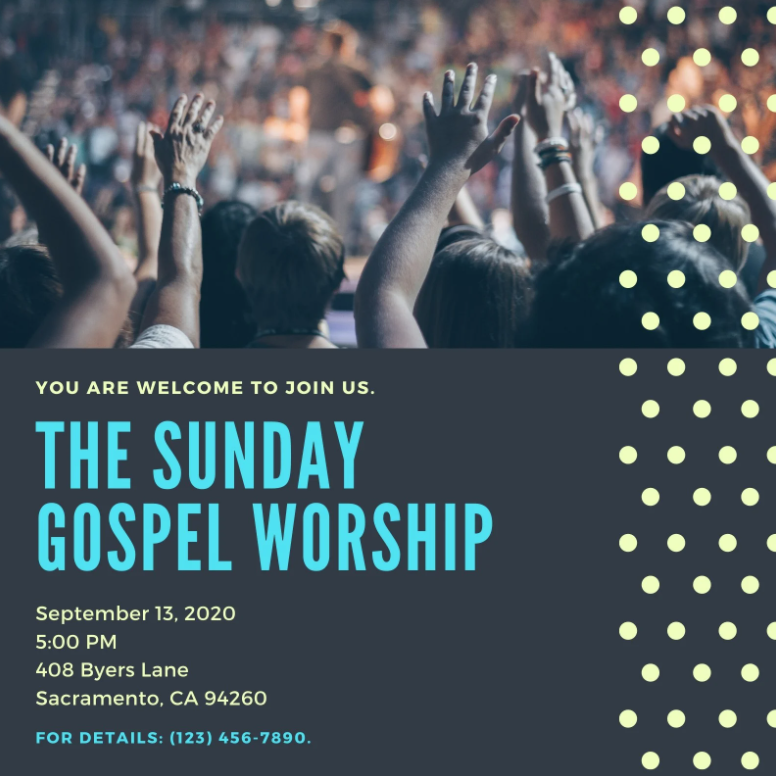
    Some websites also allow you to easily design them yourself. The picture above is an example of a free template you can find on Canva. Here’s a link to that website that has many choices of designs that you could make in 60 seconds or less.

    My church found that the best prices and customer service were with our local printer. Feel free to look around the internet and around your city to find the best printer.

    No matter what, invitations are well worth the price that you pay for them. Even if they costed ten times more than they actually do, you should still have them.

    The church invitations also make it easy for people to remember to come when they are invited.

    When you are not used to coming to church, it can be hard to remember to get up early on a Sunday morning. These invitations will serve as a reminder to many people. They might leave the invite on their counter, stick it on their fridge, leave it on their desk, etc.  but they will certainly see it multiple times.

    It’ll also make it easy for them to find directions to the church. They might not remember which church they were invited to. They might have trouble finding it online. But with the card, they will be invited, remember to come, and easily find the church. 

    That is why these invitations are so important.

    8. Livestream Your Services Well (Everything You Need to Know)

    For Better or Worse, watching a church service online is becoming a very regular event.

    Many people will watch your service online before ever deciding to come and many people will watch online thinking that they are attending church.

    In our current circumstances, it goes a long way to have a well-thought-out and well-produced online stream to your church service on Sunday mornings.

    It doesn’t have to be very complicated or glamorous.

    There are only 3 things you need to do to have a fantastic live stream:

    1. Have good video.
    2. Have good audio.
    3. Make your stream easily accessible.

    That’s it.

    So, let’s talk about how you can do all three of these things really well.

    Having Good Video

    First, you need to have good video. Many affordable cameras will give you high-quality videos that you can use to stream.

    To make the process easy, my church went to Best Buy and bought a camcorder instead of a DSLR camera. These will typically be easier to use and easy to integrate with streaming software.

    Plus, purchasing a camcorder means that you don’t have to buy additional lenses.

    You’ll want to make sure that your camera is pointed at a good angle and your zoom is at a good distance. The people online should feel like they are included in the congregation.

    You also need to make sure that the camera is in focus. If you have anyone who has worked in media at your church, this should be a super easy process.

    Here are some camcorders that are cost-effective and will work for what we need, but feel free to look around for one that fits your budget:

    • Canon VIXIA HF R700 – $300
      • This camera provides an inexpensive way to easily boost the quality of your live streams.
    • Panasonic HC-V770K Full HD – $450
      • This is a good mid-range camera, possibly for those who do not like to use Canon cameras. Like the others, it provides HD-quality video and can easily stream. 
    • Canon VIXIA HF G40 HD – $1,100
      • This camera is a great step up if you want the best quality streams. It is less cost-efficient, but this camera might have uses that would help your church in other areas.

    Follow those steps to have great video will really improve your live stream.

    Having Good Audio

    Which do you think is more important, audio or video?

    The answer might be surprising. It is audio, hands down.

    If people click your stream and you have good video and bad audio, they are very likely to click away. Bad audio is very difficult to deal with for the user.

    However, if people click your stream and it has bad video and good audio, they are less likely to click away. Good audio can sometimes make up for bad video.

    That’s why it is super important to have great audio for your live streams.

    How do you do this? Well, having good audio is mostly about equipment, but not entirely.

    Audio equipment is significantly cheaper than video equipment. But you will have to buy a good microphone and a good system to hook it up to your stream.

    Most churches have already invested in a soundboard, and that will be a very useful tool for your audio.

    For the best quality sound, I would choose a headset microphone. Your other options are a lavalier microphone or a shotgun microphone, but both of them do not provide the highest-quality sound that you can get. Headset microphones are the most versatile and provide the best quality audio. 

    Here are some microphones for every budget:

    • Samson SE10T Earset Microphone with Miniature Condenser Capsule – $110
      • While this microphone is inexpensive, it requires a connection to your already existing audio setup. It is not wireless, which can cause issues if you are far away from your soundboard.
    • Countryman E6OW5T2SL Springy E6 Omnidirectional Earset – $319
      •  This is a reliable wireless microphone with good sound quality. This is what my church used for a long time, and it was a good purchase.
    • Audio-Technica 3000 Series Wireless System Wireless Microphone System – $919
      • While this microphone is expensive, it comes with some features that might be useful for some Churches. It has great audio quality, and it comes with a receiver/transmitter that could be useful depending on your audio setup. 

    Some churches with good audio equipment still fail to equalize their tracks well. This leads to the common issue of having a very quiet live stream. It is important to make sure that you can be easily heard on the live stream.

    If you can do that with good audio, you can provide a great streaming experience. 

    Making Your Stream Accessible

    You might think that it is enough to put your stream on Facebook. But it’s not.

    You want to make sure that your stream is in as many places as possible… Especially on your website. 

    Your Facebook page might be hard to find, your YouTube channel is definitely hard to find, and neither is the first place that people will go to find your live stream.

    If someone wants to view your church service, they will go to your website.

    If you do not have your live stream available on your website, you are missing out. It is also helpful to have the stream and various other places, such as Facebook or YouTube.

    The problem is: How do I livestream to so many places at once? And how do I set it up on my website?

    The answer to the second question is easy. You can set up your live stream primarily on YouTube, and then embed it into your website. 

    Most church websites are built on WordPress, and there is a free plugin that allows you to easily put your YouTube live stream video on your website. It is called Embed Plus.

    With this plugin, you will be able to put your live stream on your website easily. 

    If you are wanting to stream directly to multiple places at once, there are a few tools that allow you to do that easily. The one that many of my friends have used is called BoxCast.

    The problem with these services is that they cost monthly. However, if you are willing to pay a monthly fee to make streaming your church services easier, it might be worth checking out. Other companies provide similar services – so feel free to search around.

    9. Help People Watching Online Join You in Person (Here’s How)

    Of course, the end goal is not to get more people into your online streams. The end goal is to get people into church – and possibly church membership.

    You might think that people will decide to come to church on their own, but it is much more effective for you to do some kind of marketing.

    Marketers understand the importance of helping customers get from one stage to the next. For example, you helped someone get from not knowing about your church to knowing about your church. Then they went from knowing about your church to watching a live stream. The next step is to get them from watching a live stream to attending on a Sunday morning.

    It’s important to think through how you help people get from one step to the next.

     So, how can you help people who are watching your live stream decide to attend church?

     First, make sure to preach the importance of the local gathering. The Bible is clear that it is wrong to forsake the gathering of the local church. The Holy Spirit Works to correct us and make us into the likeness of Christ. This includes convicting us about the importance of being in a local church.

    Second, you can simply ask people on the live stream to attend a service. Say something like this:

    “If you are watching online, I would like to invite you to join us in person next Sunday. We would love to get to meet you and to bless you in any way that we can. So come say hi!”

     Some people might not even think of coming in person. But this will show them that it’s important to you that you can know them.

     Third, you can incentivize joining in person.

    Mention that visitors who joined online can get a special gift if they join in person next week.  This gift could be something easy like a book or a gift card.

    Through all of this, make sure that the emphasis is on your desire to meet them and to see them become part of a loving community. 

    10. Host Special Services or Celebrations

    When there is a special celebration at church, people feel more obligated to show up. It’s a weird cultural thing in the United States.

    That’s why we have so many people show up for Christmas and Easter but don’t go otherwise. 

    But if you have had a special event in the past, you’ll know that more people will show up. Some of them will be visitors. Others will be people who claim your church as their church home but rarely show up.

    This is a tool you can use sparingly to boost attendance and help people get connected.

    Of course, you want to make sure that you are still feeding the church every Sunday. These celebrations can sometimes take away from your normal Ministry of the word. But if they are too common, they also stop working.

    However, having a few special celebrations a year can bring in a lot more visitors to your church.

     Here are some ideas to make some days more special:

    • A kickoff of a new series
      •  I believe that churches should preach through books of the Bible. Some churches also preach topical sermons. If you are going through a series, it’s fun to make a big event to kick off the beginning of a new series. Make invitation cards, remind the church weeks in advance, and make it a big deal.
    • The beginning of Advent
      •  People feel obligated to attend church on Christmas.  You can make the most of this by celebrating the Incarnation throughout the entire month of December. Make a big deal about Advent and encourage your members to invite their friends.
    • Mother’s and Father’s Day
      • Many churches celebrate Mother’s and Father’s Day, and it is a great idea to celebrate a special day in the church. Parenthood is a gift of God and the church has the right to teach on it and celebrated as the people of God.
    • Thanksgiving
      • While Thanksgiving is an American celebration, the concept of giving thanks is overtly biblical. Thanksgiving is a great holiday for your church to celebrate together, invite new people, and learn to give thanks to God for his grace to save us and care for us.
    • Local celebrations
      •  Every area has local celebrations. Make sure that you take advantage of yours by participating in the community and even celebrating them, when appropriate, as a congregation on Sunday morning.
    • Bring A Friend To Church Day
      • Of course, people should be inviting their friends anyway. But if you make it a special event, the odds are that many people will bring their friends when they wouldn’t have otherwise. It’s a fun way to get to know new people and introduce new people to your church.

    All of these recommendations are best done together. If you are going to host a special celebration, make sure to make invitation cards, set up a live stream, and remind your congregation of the importance of making disciples.

    Most of all, your priority as a pastor is to care for your people. You know that Hebrews 13:17 says that you will give an account for their souls.  That is a weighty calling, and I’m sure you very much feel it.

    Don’t get discouraged when your church is shrinking or you can’t seem to grow. Be grateful to God for the work that he is doing no matter what.

    And always look to Christ.

    Brooks Szewczyk

    Brooks is currently pursuing a Masters of Divinity with an emphasis in Biblical Counseling from Midwestern Baptist Theological Seminary. He is the Marketing Manager at Bethany Global University, a college dedicated to training missionaries to reach the unreached.

    Learn more about Brooks »

      5 Reasons Why Online Church Isn’t Good Enough – And Never Was

      August 6, 2020 By Brooks Szewczyk 2 Comments

      Let me show my hand – I really want you to be in a local church on Sunday.

      I know it’s a controversial topic at the moment, but I think there’s a BIG problem underlying all of the online church…

      We’ve started to view the gathering of the local church as a convenience at best. It’s more than that. It’s a necessity for the Christian.

      I want to give you 5 solid reasons your butt should be in a pew on Sunday.

      1. The Bible Commands Gathering

      The reason why we have church at all is that the Bible commands us to gather together.

      You’ve probably heard this verse before, but I’d encourage you to consider the authority of God’s word as you read this.

      And let us consider one another in order to provoke love and good works, not neglecting to gather together, as some are in the habit of doing, but encouraging each other, and all the more as you see the day approaching.

      Hebrews 10:24-25

      Neglecting to gather together is not a trivial matter – it’s a sinful act.

      2. Your Soul Needs Corporate Worship

      If God commands us to gather together, it’s because God knows best.

      We often don’t realize every way that God works in our souls through corporate worship. Humans were always dependent creatures. And the Christian life is dangerous to live alone.

      Notice in the Hebrews passage quoted above that rather than neglecting to gather, we should encourage one another.

      We need the encouragement of the local church, the leadership that God has placed in the local church, and the fellowship in the local church

      We need to have our sins called out.

      We need to see one another worship God.

      In essence, corporate worship is necessary because it reminds our souls of who God is and what he is done.

      Apart from it, we are very prone to forget.

      3. You Need the Preaching of the Word of God

      The Word of God is powerful.

      The Bible establishes the strong precedent of reading and expositing the Bible in the gathering of the local church.

      It’s true that our spiritual health is heavily dependent on our ability to read, apply, and love scripture on our own.

      But the preaching of the Word in the gathering is where we learn to do that.

      It’s the feast our souls need, and it sets the congregation up to be praying and studying together.

      4. You Need the Sacraments

      In the gathering of the local church, we see at least three sacraments we absolutely need that I want to highlight.

      First, we need communion.

      Taking the bread and wine together is not a suggestion. Jesus commanded it.

      It is in this act that we proclaim the Lord’s death until he comes again. It is a necessary means of celebrating the Passion of Christ. And we can not forsake it.

      Second, we need baptism.

      Baptism is where Christians publicly proclaim their repentance and faith in Christ. Our new life is symbolized in this sacrament.

      And it is also a command. It’s non-optional for the believer.

      When we are not meeting, the opportunity doesn’t exist very well to publicly and faithfully baptize those that God has saved.

      Third, we need the gifts of the Spirit.

      God gives gifts to his people for the good of the church.

      I think we can so often miss that point. If you’ve been given a gift from the Holy Spirit, it is likely not for you.

      The local church needs the gifts of one another, whether it is teaching or tongues or anything in between. We have all been gifted for the good of the church.

      When we neglect to gather, we lose most of the opportunities to use the gifts that God has given his people.

      5. The Church Needs You

      Not only do you need the church, but the church needs you.

      All people have been gifted by the Spirit for the good of the church, even you.

      I’m afraid we have resigned to being passive observers of the celebration rather than being active participants.

      The saints of your church need your encouragement.

      They need you to use your gifts that God has given you. After all, God has given them to you for a reason.

      Loving Your Neighbor

      I have also heard some saying that gathering together is unloving.

      Their idea is that our primary responsibility is to love one another and our secondary responsibility is to gather together.

      I have two large issues with this.

      First, it is unloving to neglect the gathering. I believe that many who say this have it backward.

      It is a common sinful proclivity for us to think that we know what is loving better than God.

      Those who say that it is unloving to gather together are greatly underestimating the importance of the local church on the health of a person’s soul.

      Second, we can’t set God’s commands against each other.

      It’s not as if God gives contradictory commands. In fact, all of God’s commands fit within the command to love our neighbor.

      Therefore, it doesn’t make logical or biblical sense to call it unloving when Christians gather together. The word of God tells you that you need the church a lot more than you think you do.

      Only One Caveat

      There is only one caveat that I will offer to this post.

      If you have been actively participating in a local church that is not currently meeting, I would recommend that you not leave that local church.

      I’m not trying to advise you to leave your church for one that is meeting. I’m trying to encourage you to attend church if it’s possible.

      Faithfulness to a local church is also important. Submission to godly leadership in your local church is a biblical command.

      But if you’re a Christian reading this and your church is meeting, please be there on Sunday.

      Do Calvinists Believe in Miracles? Explanation and Examples

      August 5, 2020 By Brooks Szewczyk 5 Comments

      In every movement within Christianity, rumors and false information start to spread. So we have to question some of the possible misinformation before we accept it. That’s why I’m digging into this topic.

      Not all Calvinists agree on the extent of miracles in the current church, but they all believe that God acts in supernatural ways. Some Calvinists believe that the Holy Spirit no longer gives any revelatory gifts, but others believe in the continual and necessary use of the revelatory gifts.

      I’ll dig deeper into exactly what this means, what Calvin himself taught, and what some popular Calvinists believe in the rest of this article.

      It Depends on What You Mean by ‘Calvinist’

      The term Calvinist can be used in one of two ways.

      First, it can refer to someone who believes in Calvin’s understanding of salvation (theologians call this sotereology).

      Some people, like myself, call themselves Calvinists because they agree with the acronym TULIP. These are called the 5-Points of Calvinism.

      They stand for:

      • Total Depravity
      • Unconditional Election
      • Limited Atonement
      • Irresistible Grace
      • Preservation of the Saints

      If a Calvinist is in this group, they might believe in miracles and the revelatory gifts of the Spirit.

      The other group of Calvinists call themselves that because they are either confessionally reformed or agree with Calvin on almost all of his views.

      To be confessionally reformed might sound confusing but it is super simple. It just means that they fully agree with one of the confessions of faith that were written during the reformation.

      None of these confessions are continuationists. Therefore, you can assume that those in this group do not believe in miracles in the way that you might think.

      However, its very important to understand what you mean when you say miracles.

      It Depends on What You Mean by ‘Miracles’

      Almost every Calvinist regardless of which group they are in would believe that God can do miraculous things.

      They do believe that God heals.

      They do believe that God works supernaturally.

      There are very few Christians, Calvinists included, which would deny supernatural acts of God.

      What Calvinists might not believe in is the continual gifting of God’s people with the power to perform miracles.

      While many believe that God heals, they do not believe that God grants people with the gift of healing.

      Many Calvinists might also push back against a common understanding of the frequency of miracles. They believe that they are a lot less frequent than many think or believe.

      Timing Matters

      Calvinists who do not believe that God currently gives specific miraculous gifts do believe that God used to.

      Every Calvinist would believe that the miracles that God performed in the Bible were true miracles that actually happened.

      The disagreement comes because many Calvinists believe that God stopped giving those gifts at a certain point in history. Other Calvinists do believe that God still give those gifts.

      Note: The most common understanding of Calvinism is compatible with continuationism. Some might disagree with this.

      What Did Calvin Teach?

      I searched through John Calvin’s Institutes of the Christian Religion to find exactly what he wrote regarding miracles.

      The most relevant piece of information came in his response to some who were asking for miracles to verify his gospel.

      He writes this to begin his response:

      In demanding miracles from us, they act dishonestly; for we have not coined some new gospel, but retain the very one the truth of which is confirmed by all the miracles which Christ and the apostles ever wrought.

      John Calvin

      You do see from this that Calvin accepts the miracles of the Bible and early church as real miracles.

      However, he said this regarding their comments:

      The deception would perhaps be more specious if Scripture did not admonish us of the legitimate end and use of miracles.

      John Calvin

      The implication that Calvin makes here is that he believes that the Bible admonishes us that miracles came to an end.

      If you continue reading through this chapter, you can come to understand Calvin’s argument. He teaches that the purpose of miracles in the early church was to verify the gospel that they were preaching.

      Since the gospel has been fully verified and the Bible is complete, he believes that miracles are no longer necessary.

      Note this important distinction:

      • Calvin does believe that God can perform miracles.
      • Calvin does not believe that God still performs miracles.

      So, Calvin did teach that miracles had ceased and therefore can’t be performed by the church today.

      Calvinists Who Believe in Miracles

      I would encourage you not to think less of any believer because of their view on miracles. Personally, I believe that the Spirit still performs miracles. But many faithful, God-loving Christians disagree with me.

      Here are a couple of examples of Calvinists that still believe in miracles and what they’ve said about it.

      John Piper

      John Piper is still one of the most influential pastors in the world, calling many to live their life in service to Jesus Christ. He jokingly even calls himself a “7-Point Calvinist” adding 2 more points to TULIP. Regarding miracles, Piper says:

      If we could collect all the authentic stories all over the world — from all the missionaries and all the saints in the all the countries of the world… we would think we were living in a world of miracles, which we are.

      John Piper

      John Piper not only believes in miracles, he believes that we are living in a world of miracles.

      Sam Storms

      Sam Storms is an influential pastor in Oklahoma City, OK. He wrote a book defending Calvinism entitled Choosing Life: The Case for Divine Election. He is also a staunch defender of miracles in the current time. He writes:

      So, does God work miracles among us, or do gifted individuals work miracles among us? Yes! God works miracles among us by awakening faith in his Word, in conjunction with or as a result of which he imparts a gracious divine enabling (i.e., a charisma, a gift) so that the believer can work miracles among us.

      Sam Storms

      Here, he defends God’s continual performing of miracles as well as God’s gifting of working miracles to his people.

      Calvinists Who Don’t Believe in Current Miracles

      Again, there are many God-loving people on this list who are worthy of our respect whether or not we agree on this.

      Here are a couple of examples of Calvinists who do not believe in miracles and what they’ve said about it.

      R.C. Sproul

      Sproul was a faithful pastor and theologian who championed the glory and majesty of God in a time when many are focused on man. He wrote this:

      I get this question all the time, “R.C., do you believe that miracles happen today?” If you want me to give the simple answer, the answer is no.

      R.C. Sproul

      He believed in the ultimate power of God, but he did not believe that God still performs miracles.

      Charles Spurgeon

      Charles Spurgeon was one of the most influential pastors and teachers in the last few hundred years of church history. He made the gospel accessible and preached nothing but Jesus Christ. Regarding miracles, he wrote:

      When the Holy Spirit was given in the earliest ages, He showed His presence by certain miraculous signs.

      Charles Spurgeon

      What Spurgeon clearly believed is that miracles were for the earlier ages when the authority of the gospel was not clearly established.

      Brooks Szewczyk

      Brooks is pursuing an MDiv with an emphasis in Biblical Counseling from Midwestern Seminary. He has a certificate in Bible and Missions and is the Marketing Manager at Bethany Global University, a college dedicated to training missionaries to reach the unreached.

      View author page »

        Theology for Beginners: What Christians Should Believe

        May 20, 2020 By Brooks Szewczyk

        Christians love to talk about theology. There is an uncountable number of books, blog posts, and podcasts that are made just for you to learn theology. But they often fail to give you the biblical foundation you need before you dig into more complicated topics.

        What should Christians believe? Christians believe in the gospel of Jesus Christ: the sinfulness of mankind, the incarnation, atonement, and resurrection. They believe in the inerrancy and authority of the Bible. And they believe in the holiness, love, and power of the Triune God.

        As time goes on, Christians should mature in their understanding of who God is. That is the meaning of theology.

        Hebrews 4:11-14 establishes that some Christians need milk and not solid food. Meaning that you have to get the basics down before you try moving on to more weighty topics.

        The goal is to be mature enough to eat solid food. In this article, I want to go over the basics of Christian theology so that you can have what you need to move on to more advanced study.

        I’ll also include a list of some common theological vocabulary you might need to know.

        The Gospel of Jesus Christ

        The gospel of Jesus Christ is the foundation for Christian theology.

        When delivering the gospel, the apostle Paul writes:

        For I passed on to you as most important what I also received: that Christ died for our sins according to the Scriptures, that he was buried, that he was raised on the third day according to the Scriptures.

        1 Corinthians 15:3-4

        While the gospel is foundational, it is also something that no Christian ever grows out of. The gospel should be your hope in every moment of every day.

        So what is the gospel?

        The Sinfulness of Mankind

        The fundamental problem addressed by the gospel is the sinfulness of mankind.

        The first man created by God, Adam, sinned by disobeying God.

        As God had warned would happen, this plunged creation into a curse of sin.

        Romans 5:12 says it this way: “Therefore, just as sin entered the world through one man, and death through sin, in this way death spread to all people, because all sinned.”

        All of humanity stands before God as guilty.

        There is no one righteous, not even one. There is no one who understands; there is no one who seeks God. All have turned away; all alike have become worthless. There is no one who does what is good, not even one.

        Romans 3:10-12

        We are inclined to disobey God.

        Our propensity isn’t toward good works and righteousness, it is toward disobedience and unrighteousness.

        Theologians usually call this total depravity.

        The Incarnation

        God became man. This is the essence of the incarnation.

        The word refers to the “becoming of flesh”. And it biblically refers to Jesus Christ, who is God, taking on humanity.

        This is summarized in John 1:14: “The Word became flesh.”

        Jesus is truly and fully human. He is not half human. He does not just look like a human. He is fully man.

        Jesus is also truly and fully God. He is not half God. He did not lose the fullness of his deity. He is fully God.

        Colossians 2:9 says it this way: “the entire fullness of God’s nature dwells bodily in Christ.”

        The Life of Jesus

        Jesus humbled himself by becoming man. And he lived on earth among men.

        He was born through the miracle of the virgin birth to his mother Mary.

        He lived and taught in 1st century Israel.

        But most importantly: he lived a perfect and sinless life.

        While we all fall short of the glory of God, Jesus did not. He did not deserve the wrath of God.

        Unlike us, he did not deserve to be separated from God.

        His earthly life and teachings are recorded in the four gospels: Matthew, Mark, Luke, and John.

        He performed miracles, preached sermons, and ultimately died in our place.

        The Atonement

        Jesus was crucified for our sins.

        Jesus died in our place, taking our punishment, and removing the wrath of God for our sins.

        Theologians sometimes refer to this as the penal substitutionary atonement.

        God is just and does not allow wickedness and evil to go without consequence.

        In fact, God hates sin. He despises wickedness and evil. And it is right for him to do so.

        Jesus died as a sacrifice on our behalf.

        He removed the wrath of God. This is sometimes called propitiation.

        But he was pierced because of our rebellion, crushed because of our iniquities; punishment for our peace was on him, and we are healed by his wounds. We all went astray like sheep; we all have turned to our own way; and the Lord has punished him for the iniquity of us all.

        Isaiah 53:5-6

        To put it another way, 2 Corinthians 5:21 says that “He made the one who did not know sin to be sin for us, so that in him we might become the righteousness of God.”

        The Resurrection

        Jesus rose from the dead.

        The Bible foretold that Jesus would be raised from the dead on the third day.

        In fact, even Jesus foretold this about himself.

        Jesus answered, “Destroy this temple, and I will raise it up in three days.” … But he was speaking about the temple of his body. So when he was raised from the dead, his disciples remembered that he had said this, and they believed the Scripture and the statement Jesus had made.

        John 2:19-22

        Jesus bodily, physically, literally rose from the dead on the third day.

        This is one of the most fundamental doctrines of the Christian faith.

        1 Corinthians 15:14 says, “If Christ has not been raised, then our proclamation is in vain, and so is your faith.”

        Jesus appeared to over 500 people after his resurrection and the apostles carried their witness of the resurrected Christ until their martyrdom.

        The Great Commission

        The Great Commission refers to the words of Jesus before he ascended.

        All authority has been given to me in heaven and on earth. Go, therefore, and make disciples of all nations, baptizing them in the name of the Father and of the Son and of the Holy Spirit, teaching them to observe everything I have commanded you. And remember, I am with you always, to the end of the age.

        Matthew 28:18-20

        There are two important statements worth memorizing here.

        First, Jesus commands us to make disciples. A disciple is a follower of Christ.

        This means proclaiming the gospel and teaching people to obey the Lord.

        Second, Jesus promised to be with us.

        This is one of the most comforting promises in all of the Bible. Jesus will never leave us. And he is always with us.

        The Doctrine of the Bible

        The Bible is the word of God.

        It is inspired by God, meaning that they were the words of God. It was written by apostles and prophets used by God to compose the Bible.

        The Bible contains 66 books and is divided into two testaments. There are 39 books of the Old Testament and 27 books of the New Testament.

        The greatest discipline every Christian should be always developing is to read and understand the Bible.

        The Inerrancy of the Bible

        Inerrancy simply means that the Bible does not contain any errors.

        Everything it says is true. The Bible is completely trustworthy because it is given by a perfect, all-knowing God who cannot lie.

        The Bible is not only free of errors, it also cannot make errors.

        I know this is a nuance, but it is important to know and believe that the Bible is both inerrant and infallible.

        To be infallible means that the Bible can not make errors.

        The Sufficiency of the Bible

        The Bible is all we need to be able to know God, to understand humanity, and to live a godly life of faith.

        The sufficiency of the Bible does not mean that the Bible contains every answer to every question.

        The Bible won’t tell you how to change your tire, for example.

        But the Bible tells us everything we need to know about God.

        The Bible is a gift from God that God intended to be complete. God didn’t intend that the Bible would lack necessary information.

        All Scripture is inspired by God… so that the man of God may be complete, equipped for every good work.

        2 Timothy 3:16-17

        Scripture is able to make us complete in our faith and equip us to live a life of godliness.

        The Authority of the Bible

        God wrote the Bible and he is the Lord.

        The Bible is not just advice. It is authoritative. It has power.

        When you received the word of God that you heard from us, you welcomed it not as a human message, but as it truly is, the word of God, which also works effectively in you who believe.

        1 Thessalonians 2:13

        Jesus Christ is Lord. Every tongue will confess this. Every knee will bow to him.

        His word is not to be taken lazily. Hebrews 5:11 tells us the folly of “being too lazy to understand“.

        The commands of the Bible should be obeyed. The truth of the Bible should be revered. And the Author of the Bible should be worshiped.

        The Accessibility of the Bible

        The great reformer Martin Luther commented that, “the Holy Spirit is the plainest writer and speaker in heaven and earth.”

        The books of the Bible contains many different types of literature. From epistles and narratives to prophecy and apocalypse.

        But that doesn’t mean the Bible is hard to understand.

        And we have the Holy Spirit to illuminate and apply his word.

        It might take study. It might mean looking into the text. But the Bible is easily understood.

        The Bible is not written to be tricky. It’s not meant to be complicated.

        It is meant to be written so that all people everywhere have a testament of God and the gospel.

        The Doctrine of God

        The New City Catechism asks the question “What is God?” Their answer is this:

        God is the creator and sustainer of everyone and everything. He is eternal, infinite, and unchangeable in his power and perfection, goodness and glory, wisdom, justice, and truth. Nothing happens except through him and by his will.

        The theologian A.W. Tozer said, “What comes into our minds when we think about God is the most important thing about us.”

        The study of the attributes of God is often called theology proper.

        I’ll go over what I believe are some of the most foundational characteristics of God.

        The Holiness of God

        The only attribute of God mentioned three times in a row is his holiness.

        Holy, holy, holy,
        Lord God, the Almighty,
        who was, who is, and who is to come

        Revelation 4:8

        This is sung by angels surrounding the throne of God day and night.

        The holiness of God means that he is completely perfect.

        He is perfect in his actions, his intentions, his character, his wisdom, and all of his attributes.

        It means that he is other than us. His perfection is above any other perfection.

        His goodness are beyond the human capacity for goodness.

        His love and power are infinitely beyond our greatest ideas of them.

        God is holy.

        The Love of God

        God is infinite in his love.

        The one who does not love does not know God, because God is love.

        1 John 4:8

        God’s love is his goodness being acted out on his creatures.

        It is his benevolence and care in action.

        It is the love of God that he died for us, cares for us, and makes us holy.

        It is the love of God that undeserving sinners wake up every day and have the opportunity to repent.

        God’s love is an extension of his goodness and kindness.

        The Power of God

        God has all authority over his creation.

        He has all power to do whatever he chooses.

        Our God is in heaven and does whatever he pleases.

        Psalm 115:3

        There is nothing outside of the control of God. There is nothing that surprises him.

        There is nothing that has ever happened that has frustrated the plan of God.

        The complete power and authority of God over all things is usually referred to as his sovereignty.

        The Trinity

        God is Trinity.

        God is three persons: the Father, the Son, and the Holy Spirit.

        God is one being with one nature and one substance. The Father, Son, and Holy Spirit are equal in power and glory.

        The idea of the Trinity might seem a little confusing at first, but it is a very foundational idea.

        It impacts every other area of theology.

        The Athanasian Creed was written in the first few hundred years of the church and is one of the oldest standards for understanding the Trinity. It says this:

        We worship one God in trinity and the trinity in unity, neither blending their persons nor dividing their essence. For the person of the Father is a distinct person, the person of the Son is another, and that of the Holy Spirit still another. But the divinity of the Father, Son, and Holy Spirit is one, their glory equal, their majesty coeternal.

        God is not three parts. He is not three gods.

        God is also not one person who manifests in three different ways.

        If this seems confusing now, you’ll more easily understand it as you continue to study.

        Resources for Beginners

        If you’re looking for books to help you jump-start your theological journey, we’ve created this video just for you.

        Common Vocabulary

        Holiness – the holiness of God means that he is completely other than us and is perfect in his actions, his intentions, his character, his wisdom, and all of his attributes.

        Incarnation – the incarnation is that the Son of God became man and took on flesh

        Inerrancy – inerrancy means that the Bible does not contain any errors or imperfections.

        Infallibility – infallibility means that the Bible is not able to make errors because it is the word of the perfect God.

        Passion – the passion refers to the death of Jesus Christ on the cross as the atonement for our sins.

        Penal Substitutionary Atonement – this is the doctrine that Jesus died in our place, taking our punishment, and removing the wrath of God for our sins.

        Propitiation –propitiation is the removal of the wrath of God through the sacrifice of Jesus.

        Sin – sin is disobedience to God or his law, it is wickedness or evil.

        Sovereignty – sovereignty is the complete power and authority of God over all things.

        Theology Proper – theology proper is the study of the attributes of God

        Total Depravity – total depravity refers to the completely fallen nature of humanity in which we are inclined toward evil and unrighteousness.

        Trinity – Trinity refers to the triune nature of God as three divine persons with one essence, nature, and being.

        Summary

        Teaching complex doctrines without laying the proper foundation leads to deep theological issues and confusion.

        We have to understand the gospel, our justification and redemption.

        We have to know the Bible is our only authority.

        And we have to know who God is and how to worship him.

        When we have the right foundation, we can mature and move on to solid food.

        While we never outgrow or become too mature for the foundational doctrines, we cannot grow without their foundation.

        Brooks Szewczyk

        Pastoral Resident, Cornerstone Community Church

        Master of Divinity, Midwestern Baptist Theological Seminary; Bachelor of Arts in Biblical Studies, Spurgeon College; Certificate in Bible & Missions, Bethany Global University. Former Editor-in-Chief at Just Disciple; published in Cornfield Theology and various other publications.
          • « Go to Previous Page
          • Page 1
          • Page 2
          • Page 3
          • Page 4
          • Go to Next Page »
          • Facebook
          • Instagram
          • LinkedIn
          • Twitter

          Copyright © 2016–2026 Brooks Szewczyk